


I- LaUncH
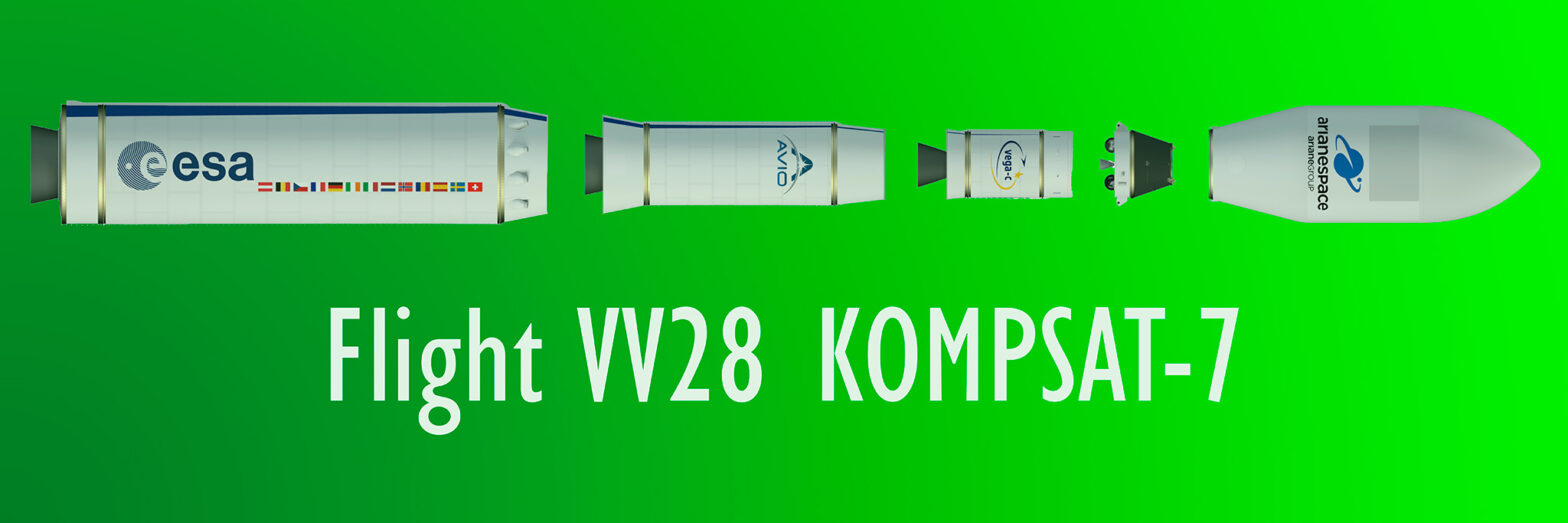
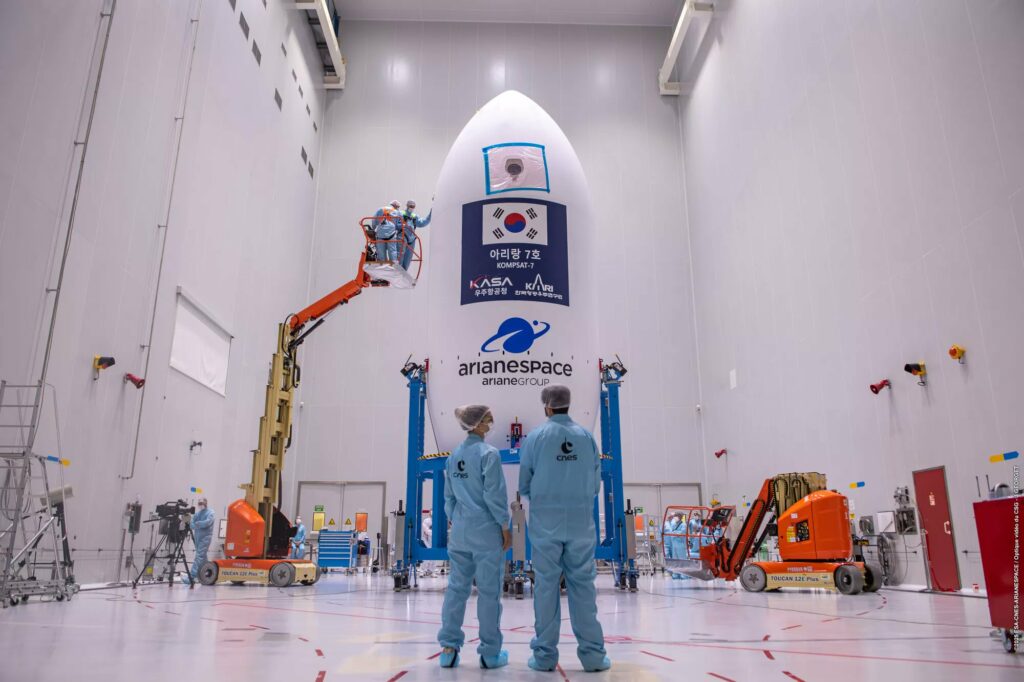
On December 1, 2025, at 17:21 UTC, the KOMPSAT 7 (KOrea Multi-Purpose SATellite-7) will lift off from the Guiana Space Center (CSG) in Kourou, French Guiana, aboard a Vega-C rocket. This launch, operated by Arianespace, will mark the VV28 flight and place the satellite into a sun-synchronous orbit (SSO). This orbit allows KOMPSAT 7 to pass over the same terrestrial areas at consistent local times, ensuring regular and optimal coverage for Earth observation.
The selection of Vega-C, the enhanced version of Europe’s light launcher, is due to its ability to deploy medium-sized satellites (around 2,000 kg for KOMPSAT 7) into low Earth orbits.
II- A revolution in Earth observation
KOMPSAT 7 is set to replace KOMPSAT-3A, a satellite that has already proven its worth by providing high-resolution images for South Korea. However, KOMPSAT 7 goes much further with its primary instrument: the AEISS-HR (Advanced Earth Imaging Sensor System with High Resolution).
- Resolution Enhancement: With its AEISS-HR instrument, KOMPSAT 7 delivers a panchromatic resolution of 30 cm (compared to 50 cm for KOMPSAT-3A), enabling unprecedented detail in South Korean satellite imagery.
- Multispectral Precision: In color, the resolution improves to 1.2 meters, ideal for analyzing soil, vegetation, and urban areas. In near-infrared, it reaches 4 meters, significantly enhancing data quality for applications like mapping, precision agriculture, and environmental monitoring.
- Enhanced Autonomy: By reducing reliance on foreign data, KOMPSAT 7 allows South Korea to fully control its space imaging resources—a strategic asset for national security and territorial management.
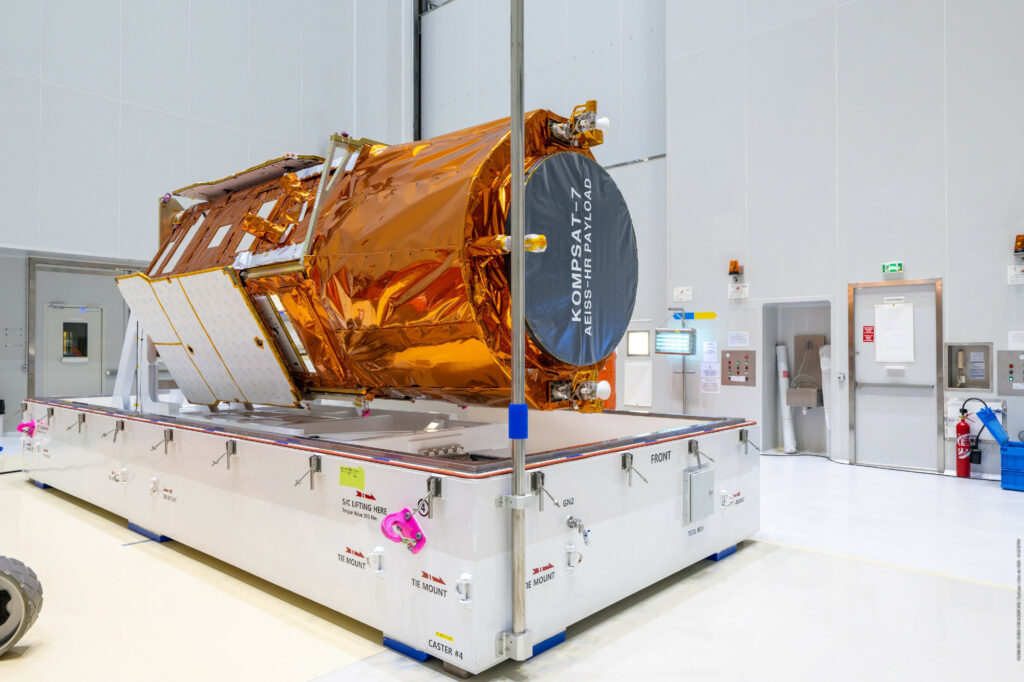
Cet instrument, développé par le KARI (Korea Aerospace Research Institute), représente une avancée majeure par rapport aux générations précédentes, tant en termes de résolution que de rapidité de transmission des données.
III- Intégration dans La gamme
KOMPSAT is a family of satellites serving South Korea, marking its evolution in space observation:
- KOMPSAT-1 and 2: Initial demonstration and mapping missions.
- KOMPSAT-3/3A: Introduction of high-resolution optical imaging.
- KOMPSAT-5: Addition of Synthetic Aperture Radar (SAR) for all-weather observation.
- KOMPSAT-6: Enhanced radar capabilities, complementing the fleet.
- KOMPSAT-7: The pinnacle of the series, achieving the highest optical resolution ever for a South Korean satellite.
This progression reflects South Korea’s ambition to become a major player in space observation, combining optical and radar imaging to meet all national needs.
IV- KOMPSAT and South Korea’s Space Sovereignty
As we have seen, the KOMPSAT program embodies South Korea’s strategy to strengthen its space sovereignty:
- Technological Independence: By developing its own satellites, South Korea reduces its reliance on foreign data—a critical issue for national security and planning.
- Dual Capabilities: KOMPSAT satellites serve both civilian missions (mapping, agriculture, environmental monitoring) and defense applications, enhancing the country’s resilience in times of crisis.
- Continuous Innovation: Each new generation of satellites incorporates more advanced technologies, positioning South Korea as a regional leader in Earth observation.
KOMPSAT is not just about observation—it’s about securing South Korea’s place in the space age, ensuring that the nation remains at the forefront of satellite technology, data autonomy, and space-based innovation. With each new satellite, South Korea strengthens its ability to monitor its territory, protect its interests, and contribute to global scientific and commercial advancements.
To learn more
- Vega-C on the Europe’s Spaceport web site
- Vega-C on Wikipedia
- Launch to be broadcast on d’Arianespace’s channel